

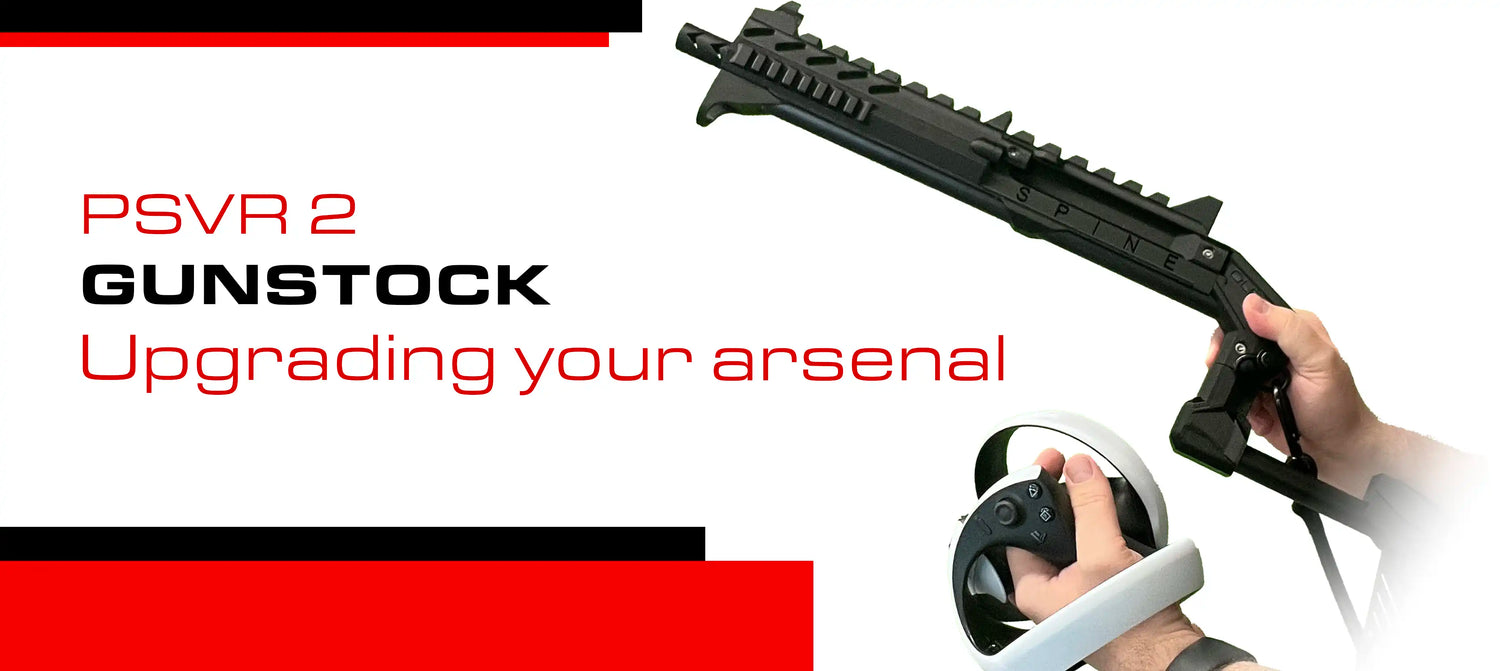

Most pages about PSVR2 gun stocks will tell you a stock steadies your aim, adds immersion and gives you an edge. All true, and all of it skips the part that actually decides whether you'll enjoy the thing: whether the game you play lets you tell it where your real stock is.
On Quest and PC, that setting is common enough that people forget it exists. On PSVR2 it's close to absent. We went through the PlayStation Store listings and the developers' own notes for five of the biggest PSVR2 shooters, and exactly one of them has physical gunstock calibration written down anywhere by the studio that made it.
That doesn't mean skip the stock. It means buy a different one than you might otherwise, and set your expectations in the right place. Every price is printed below.
What a gun stock actually changes on PSVR2
Hold a Sense controller in each hand, arms out, and you have two floating points with nothing connecting them. Every tiny wobble in your wrists shows up at the end of the barrel, magnified by distance. Your arms tire. Your shots drift.
A stock joins the two controllers to one rigid frame and braces that frame against your shoulder or chest. Three points of contact instead of two. The physics are the same as a real rifle, which is why real rifles have stocks.
What changes in practice:
- Sustained aim gets much steadier, especially at range and especially when you're tired.
- Long sessions stop being an arm workout, because the weight loads into your shoulder.
- Reloads and weapon handling feel like one object rather than two hands pretending.
What doesn't change: your reaction time, your map knowledge, and your ability to hit a target you can't see. A stock is a stability tool. It won't make you good.
There's one more thing worth saying plainly, because PSVR2 owners ask it constantly. A stock does not modify your headset or your controllers. The Sense controllers clip into mounts and come back out. Nothing is glued, nothing is opened, and nothing about it is permanent.
Which stocks fit a PSVR2 Sense controller
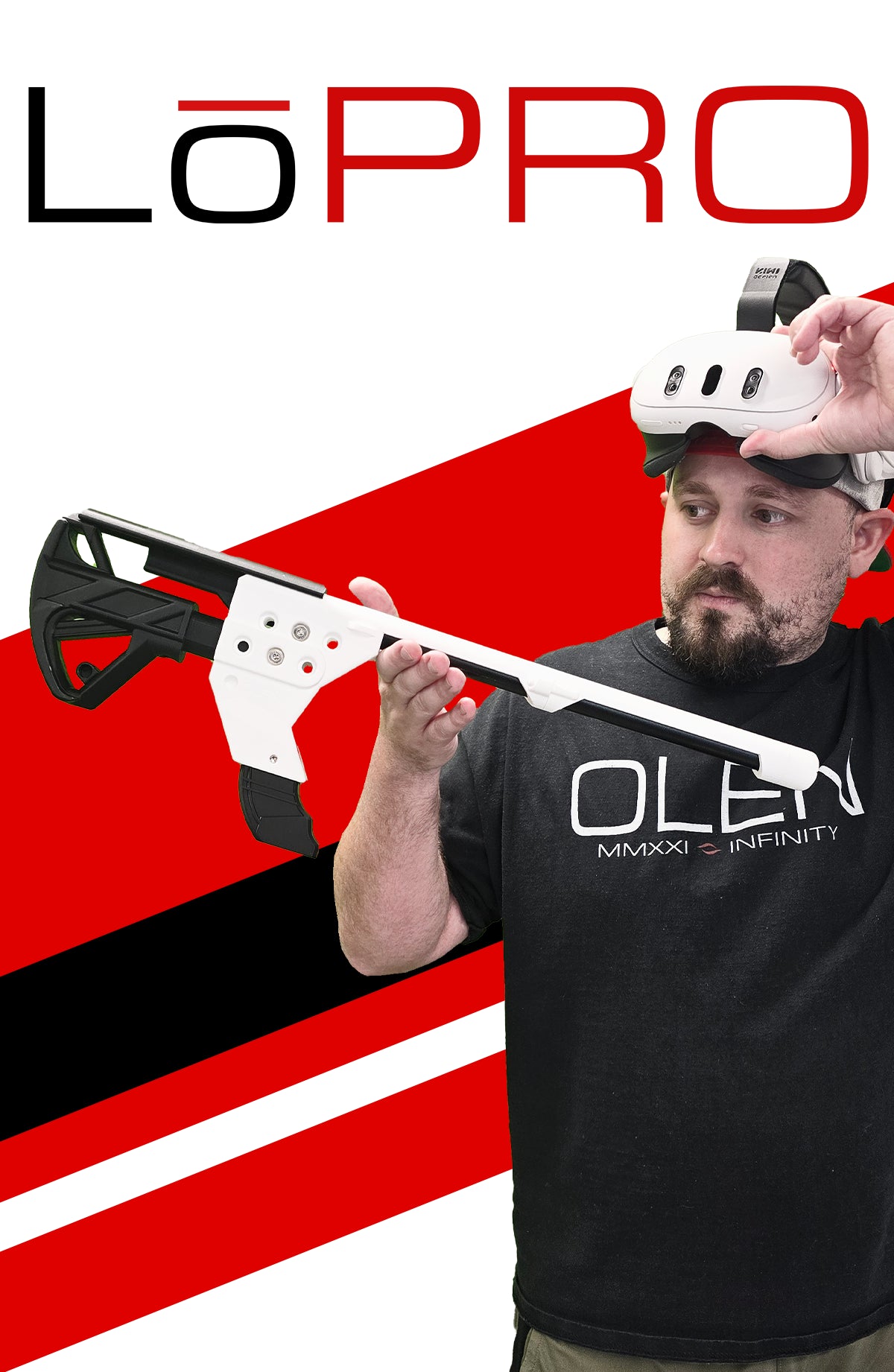
The Sense controller has an unusual shape, that orb tracking ring at the base, so it needs mounts cut for it specifically. Two of our three platforms are made in a PSVR2 version. LoPRO is not one of them.

The full PSVR2 price list
These are the prices for the PSVR2 option on each build, checked against our own store the day this was written.
| Build | PSVR2 price | What it is |
|---|---|---|
| The Asset, Solo Edition | from $24.99 | One controller mounted, one hand free. Pick your trigger hand at checkout. |
| The Asset, STKR Edition | $31.99 | The entry two hand stock. Left or right-handed. |
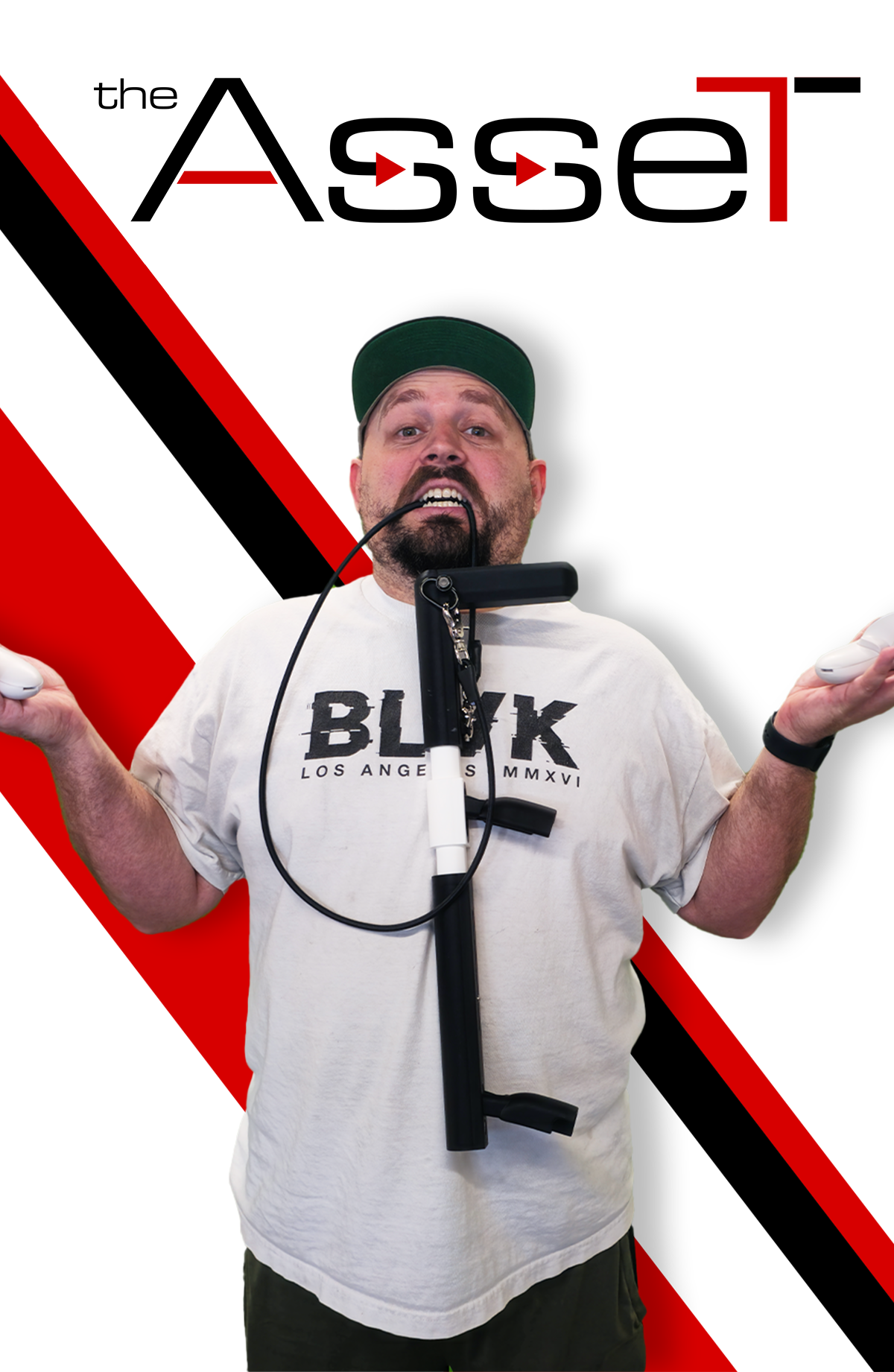
| The Asset | $57.99 | The standard build, in Onyx or Ghost. |
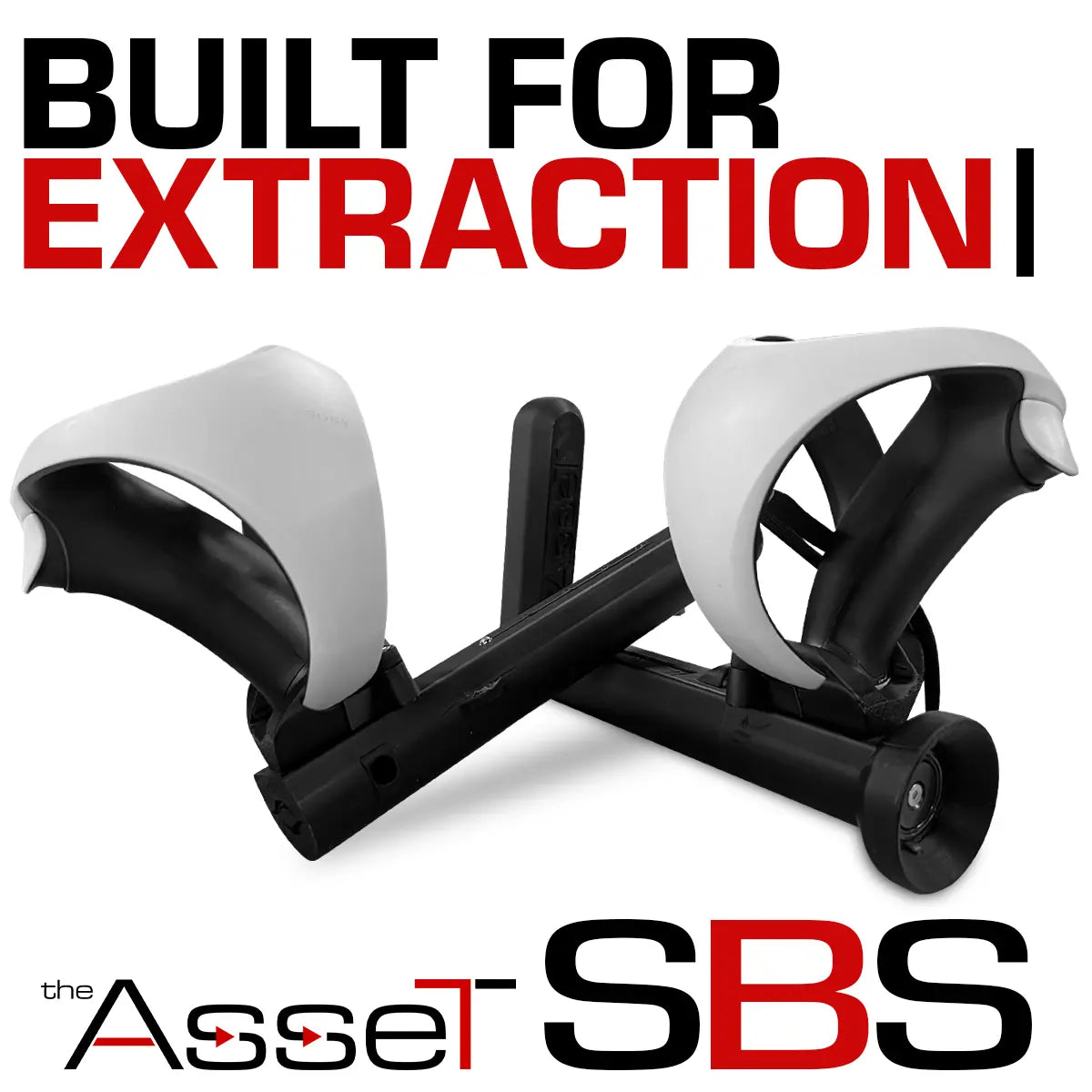
| The Asset, SBS STKR Edition | $71.99 | Side by side frame with the STKR stock. |
| The Asset, SBS Edition | $77.99 | Side by side frame. Ships with Stat Grips. |
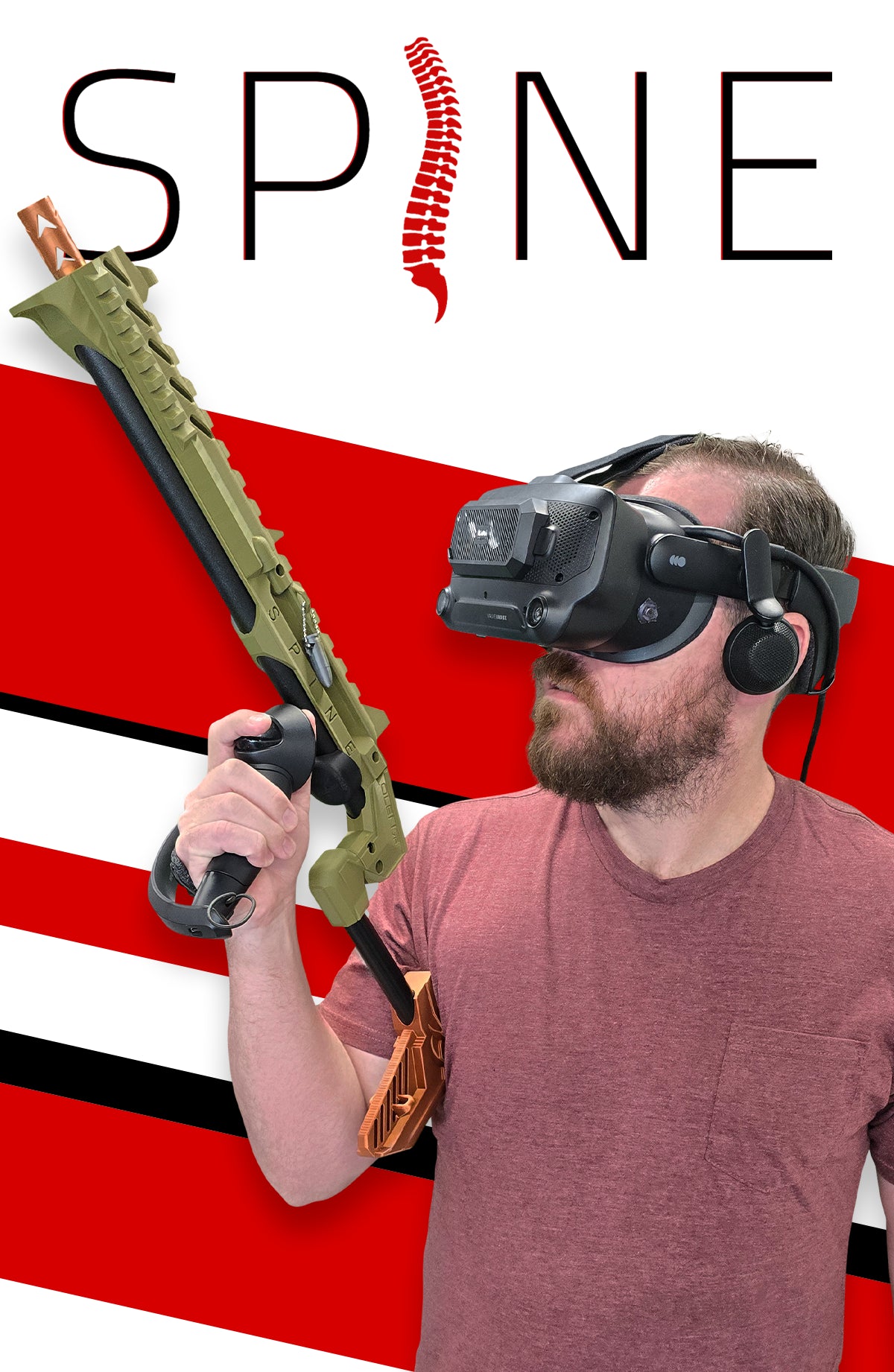
| SPINE, Onyx or Ghost | $85.99 | Magnetic mounts, adjustable from 24 to 28 inches. |
| SPINE, Smoke | $90.99 | Same stock, premium colorway. |
| SPINE, Chief | $100.99 | Same stock, top colorway. |
| VAIL Edition Asset, SBS STKR | $105.00 | Modded collaboration build. |
You can see all of them in the PSVR2 gun stocks collection. If you want the longer argument about build types rather than headsets, that lives in the VR gunstock buying guide.
What comes in the box
The controller mounts are included with the stock. You don't buy them separately and you don't need to, which is worth saying because the question comes up every week. We do sell PSVR2 controller mounts on their own at $25.99, but that listing exists for two reasons only: spares, and people who own a second headset and want a second set of mounts for the same stock.
That second case matters more than it sounds. Mounts are the headset-specific part. The stock isn't. If you move from PSVR2 to something else in two years, you buy mounts, not another stock.
Left-handed players, read this bit
Two of the PSVR2 builds let you choose your dominant hand when you order: the Solo Edition and the STKR Edition. Both are listed as left or right-hand at checkout, at the same price, and you can buy the extra parts later if you want to switch a stock to the other hand.
We mention it because most PSVR2 stock options on the market are built right-handed and say nothing about it until the thing arrives. If you're left-handed, choose the hand on the product page before you add to cart. Not after.
Which one should you actually buy

If you're not sure you'll like it
Start with the Solo Edition at $24.99. One controller sits in the mount, the other hand stays free, and you get most of the stability benefit for less than the price of a PSVR2 game. It's the honest answer for anyone who suspects a gun stock might end up in a cupboard. Plenty of people stop here and never want more.
If you play shooters most weeks
The Asset at $57.99 is the one most PSVR2 buyers want. Both Sense controllers on one frame, the shape you picture when somebody says gunstock, and it's the price point where the design stops making compromises. If you only read one line of this guide, read this one.
If length is the problem
SPINE starts at $85.99 for PSVR2 and adjusts between 24 and 28 inches. That's the one to buy if you're unusually tall or short, or if the headset gets passed around a household and a fixed length will annoy somebody. It uses magnetic mounts, so the controllers come off in about a second when you need to charge or hand over.
One honest caveat on SPINE, because we'd rather you heard it here. Those flat magnetic mounts grip a round body, which is not much contact area. Pull the stock hard into your shoulder and they can pop loose. For most players that never comes up. If you're the sort who yanks a rifle into the pocket like you're clearing a room for real, The Asset's fixed mounts are the safer choice.
The calibration question, which is the real PSVR2 problem
PSVR2 is a different platform from Quest in one way that matters a lot and gets almost no coverage. We'll put our position up front: most PSVR2 shooters will not let you tell them where your stock is, and that should change which stock you buy.

A physical stock and a virtual stock are not the same feature
Physical gunstock calibration is a setting that asks you to hold your real stock in a reference position so the game can line its virtual barrel up with your actual hardware. Without it, the gun in the game points somewhere slightly different from the gun in your hands, and your brain spends the session compensating.
A virtual stock is a completely different thing. It's software that stabilizes a two-handed hold for people with no hardware at all. Useful, but it's not stock alignment, and a few game menus list it in a way that makes people think they've found the setting they were looking for.
What the PSVR2 studios have published
| Game on PSVR2 | Physical stock calibration | Evidence |
|---|---|---|
| Ghosts of Tabor | Documented | Named in Combat Waffle Studios' own patch notes. Those notes cover the PC and Quest builds, so we can't confirm it's identical in the PSVR2 version. |
| Pavlov | Unclear | Vankrupt's public feedback board marks one merged stock request as done, while a separate gun stock calibration request sits open. |
| Into the Radius 2 | Not documented | A request for physical gunstock calibration has been on the official suggestions forum since September 2024 with no developer reply. |
| Breachers | Not documented | Has a Virtual Stock option, which is the software kind. Triangle Factory discuss it as a preference, not as stock alignment. |
| The Light Brigade | Not documented | A Funktronic Labs developer pointed players at hand offset sliders in the XR settings and asked what else stock users needed. |
We checked all of this in October 2026 against PlayStation Store listings, studio patch notes and official developer posts. Where a studio has published nothing, we've said so instead of guessing. If you find a setting we've missed in one of these games, tell us and we'll correct the table.
So what do you do about it
Two things, and neither is complicated.
First, when a game has no calibration setting, pick a stock whose geometry you can adjust yourself. A stock that only fits one way forces you to adapt to it. A stock with an adjustable length, or one where you can shift the mount position, lets you move the hardware until the sights sit where the game thinks they are. This is the reason we'd push a PSVR2 buyer toward adjustability harder than we'd push a Quest buyer.
Second, give it a week. Nearly every player who reports that their stock feels misaligned is describing the first two sessions. Your aim recalibrates around a small fixed offset faster than you'd expect, because it's consistent. A wobbling freehand hold is not consistent, which is the whole reason the stock helps.
And if a game does have the setting, use it before you form an opinion. In Ghosts of Tabor specifically, set your hand rotation offset first and the gunstock calibration second. Doing it the other way around breaks the result, which has confused a lot of people.
PSVR2 shooters worth owning a stock for
These are the five we'd point a PSVR2 owner at. All of them are confirmed on the PlayStation Store, which is less obvious than it sounds given how many VR shooter roundups quietly list games that never shipped on PSVR2 at all.
Ghosts of Tabor

Extraction shooter, and the best argument for a stock on the platform. You're holding position, watching a doorway, and the thing that kills you is a shot you pulled wide because your arms were shaking after ten minutes of waiting. It also happens to be the one game here with calibration in the studio's notes. On the PlayStation Store, and we've written separately about running The Asset in Tabor on PSVR2.
Pavlov

The multiplayer shooter most PSVR2 owners end up in, and a game where a steady hold is the difference between trading kills and winning them. Worth knowing that the PSVR2 version is called Pavlov, while the Quest build is a separate product called Pavlov Shack. Buying advice for one doesn't always apply to the other. On the PlayStation Store.
Into the Radius 2

New on PSVR2 as of 8 October 2026, so this one is about as fresh as it gets. Slow, tense, heavy on weapon handling, and the kind of game where you spend real time lining up a single shot. No published calibration setting, which is a shame given how much of the game is aiming. On the PlayStation Store.
Breachers

Round-based attack and defend, close to Rainbow Six Siege in structure. Short rounds, no respawns, and one bad shot ends your round. It has a Virtual Stock option in its settings, which is the software feature rather than physical alignment, so don't go hunting for a calibration menu that isn't there. On PlayStation.com.
The Light Brigade

A roguelike where you pick a class, die, and come back. Bolt action rifles, deliberate shooting, and no multiplayer pressure, which makes it a good first game to test a new stock on. There's no gunstock setting, but a developer has pointed players at the hand offset sliders in the XR settings, and those get you most of the way. On PlayStation.com.
One to know about: Firewall Ultra
If you're reading older PSVR2 recommendations, you'll see Firewall Ultra near the top of most of them. Don't buy a stock for it. Sony terminated its online features on 17 September 2026 and the PlayStation Store page now says the game is no longer playable. We're including it because a surprising number of lists still have not caught up.
For the wider picture across every headset, we keep a separate roundup of the best VR shooting games and which ones support a gunstock.
Questions people ask before they buy
Is a PSVR2 gun stock worth it?
If you play shooters more than occasionally, yes. The stability gain is immediate and obvious, and the fatigue difference shows up the first time you play for more than half an hour. If you mostly play seated single player games, or shooters are a once a month thing for you, it's a harder sell and the $24.99 Solo Edition is the sensible way to find out.
Will a stock interfere with PSVR2 tracking?
Sony tracks the Sense controllers using cameras in the headset reading the controllers' tracking rings, so anything that hides a ring from the headset can in principle affect tracking. In practice, mounting controllers on a stock holds them in a stable, predictable position in front of you, which is the easy case for a camera. Sony has not published anything about gunstocks specifically, and we're not going to invent a position they haven't taken. If you want the primary source, it's Sony's own PSVR2 hardware documentation.
Can I charge the Sense controllers without taking the stock apart?
You unclip the controllers and charge them as normal. On SPINE the magnetic mounts make that close to instant. On The Asset it's a few seconds longer. Neither requires tools.
Do I need to buy mounts separately?
No. Every stock ships with the mounts for the headset you selected. The standalone mounts listing is for spares, or for covering a second headset with the same stock.
What happens if I switch headsets later?
You keep the stock and buy new mounts. That's the main reason the mounts are a separate part in the first place.
Where to start
If you want the short version: buy The Asset at $57.99 if you play shooters regularly, the Solo Edition at $24.99 if you want to test the idea first, and SPINE from $85.99 if an adjustable length solves a real problem for you. All of them are in the PSVR2 collection.
And go in knowing that most PSVR2 games won't hand you a calibration slider. That's the platform, not the stock. Pick hardware you can adjust, give your aim a week to settle, and the rest takes care of itself.
Game screenshots and trailers are used to illustrate the games discussed and remain the property of their studios: Combat Waffle Studios and Neem Interactive (Ghosts of Tabor), Vankrupt Games (Pavlov), CM Immersive (Into the Radius 2), Triangle Factory (Breachers), Funktronic Labs and Creature Label (The Light Brigade).

Leave a comment
This site is protected by hCaptcha and the hCaptcha Privacy Policy and Terms of Service apply.